
Before presenting the details of the topic, it is worth noting Young Lee’s qualifications: he is a licensed acupuncturist in the States of NJ and NY. He is a Diplomat in Acupuncture certified by the NCCAOM. He holds an MS degree from Tri-State College of Acupuncture, the acupuncture school that taught ‘trigger point needling’ using the textbook by Simons and Travell ‘The Trigger Point Manual”. He holds several patents on needling devices (US Patent 5735868,1996; US Patent 5996167, 1999; US Patent 6117155, 2000; US Patent 2021/0378911, 2021).
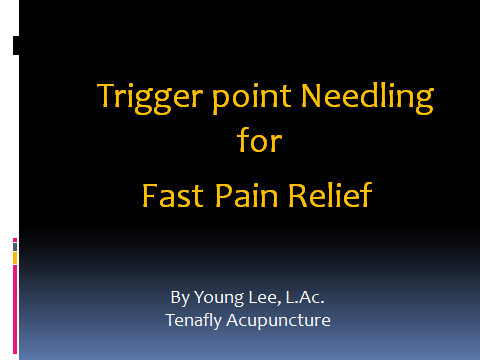
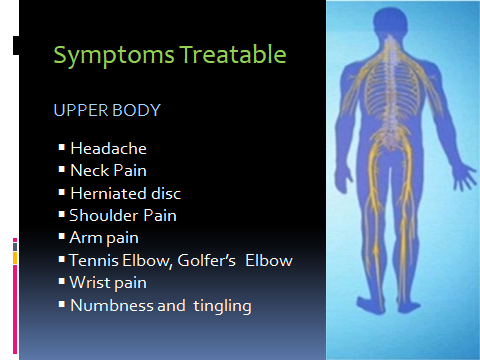
Symptoms that can be treated with trigger point needling in the upper body include tension headache, neck pain, shoulder pain, arm pain, tennis elbow, golfer’s elbow, wrist pain, and numbness and tingling in the fingers.
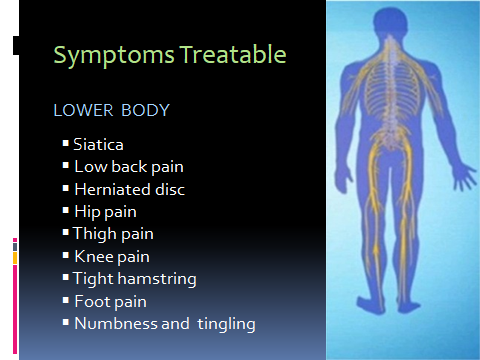
Symptoms that can be treated with trigger point needling in the lower body include sciatica, low back pain, hip pain, thigh pain, knee pain, hamstring pain, foot pain, and numbness and tingling in the toes.
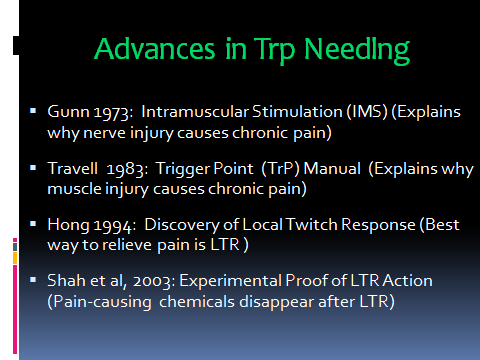
There have been several major developments in trigger point needling. In 1973, Gunn introduced intramuscular stimulation – a dry needling method – for treating chronic pain. In 1983, Simons and Travell published “Trigger Point Manual,” which introduced a detailed description of trigger points. In 1994, Hong presented clinical data showing that dry needling with a local twitch response is the most effective for treating pain symptoms. In 2003, Shah and others at the National Institutes of Health experimentally confirmed that pain chemicals disappear after an LTR elicitation.
Gunn postulated that chronic pain is due to nerve injury at the level of the nerve root during an accident, which results in muscle shortening. This shortened muscle pulls on the muscle, further shortening the muscle fibers. This traction effect further injures the nerve root, and the effect is sustained in a vicious cycle. This is called the Gunn’s radiculopathy model for chronic pain.
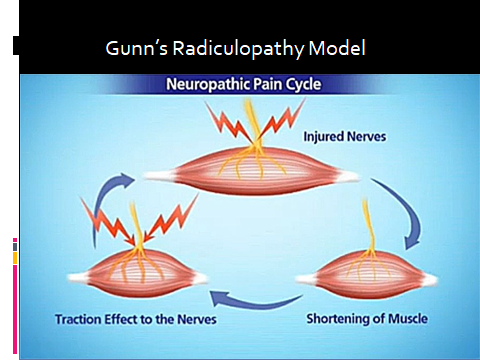
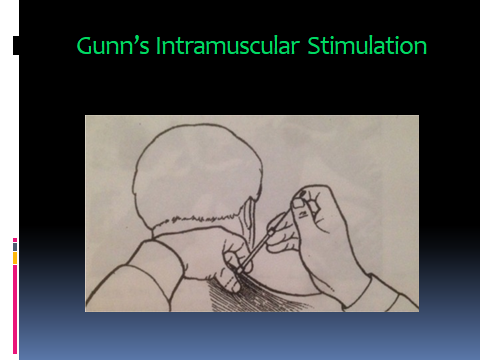
Gunn treated chronic pain by inserting a needle into the region of muscle shortening. The needle is left in place for some time (just as in traditional acupuncture), or it is moved up and down (this is called ‘dry needling’) to stimulate the shortened muscle and relax the shortening. He did not mention local twitch response (LTR) specifically.
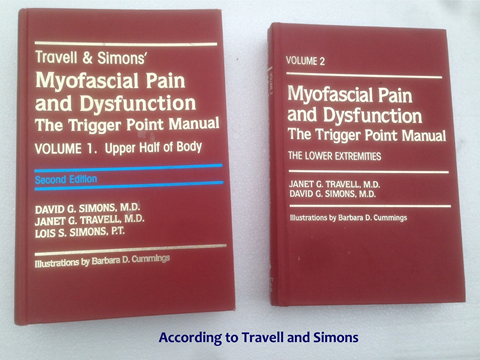
Simons and Travell wrote two books on ‘Myofascial Pain and Dysfunction’ for Upper and Lower Extremities, respectably, as shown here. These books were used as textbooks in my former acupuncture school, Tri-State College of Acupuncture, headed by Mark Sim. These two books were used to train students on trigger point needling, along with traditional acupuncture. Mark Sim called the trigger point needling Acupuncture Physical Medicine.
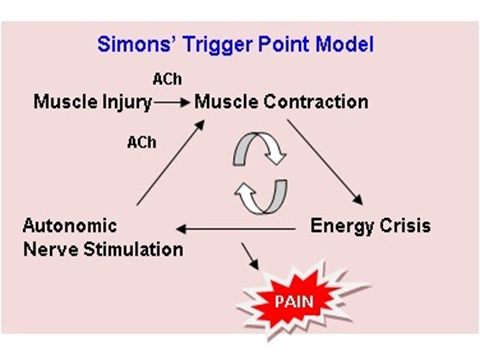
Simons proposed a different view of the vicious pain cycle based on muscle injury. When a muscle is injured, acetylcholine is released, and this causes muscle contraction. Increased energy demand in this contraction zone results in an ischemic condition. This creates an energy crisis there. This, in turn, stimulates the autonomic nervous system, which releases acetylcholine and pain chemicals. The acetylcholine causes further muscle contraction, thereby maintaining the vicious pain cycle. The pain chemicals released cause pain.
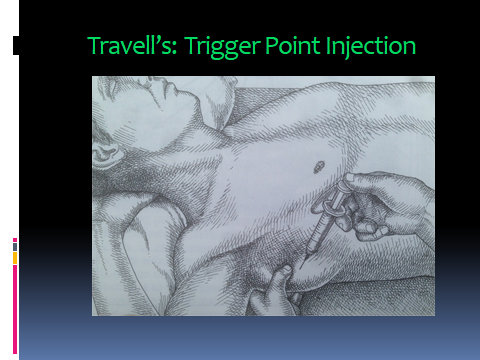
Trigger point injection used by medical doctors to reduce pain is suggested by Travell. The medications injected include lidocaine (for short-term pain relief), corticosteroids (to reduce inflammation), or saline. When no medication is injected, it is called ”dry needling”. Hong found that dry needling alone is often more effective than ‘wet’ needling of injecting medications.
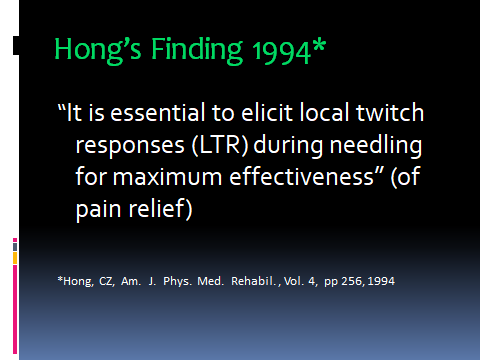
Dr. Hong of University of California Irvine discovered that eliciting Local Twitch Responses during dry needling is essential for maximum effectiveness of pain relief.
In my opinion, this is the most significant finding in the field of pain management.
Hong discovered that if a needle is placed in an area of contracted muscle fibers, the muscle would twitch spontaneously (Hong, 1994). He observed that this local twitch response (LTR) breaks the shortening of muscle fibers and relaxes the muscles. This allows the muscle to fully relax, breaking the pain cycle and enabling healing.
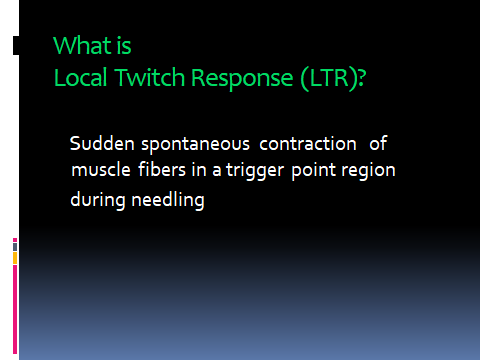
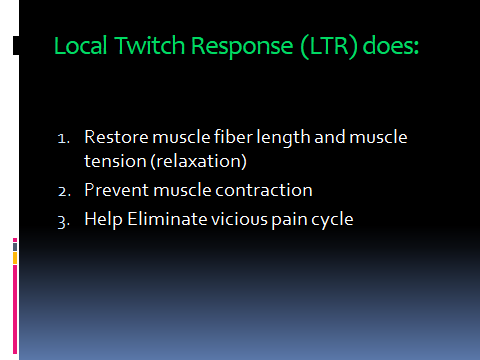
The LTR does three things: it relaxes the muscle to restore the original tension; it breaks the vicious pain cycle; and it prevents muscle contraction.
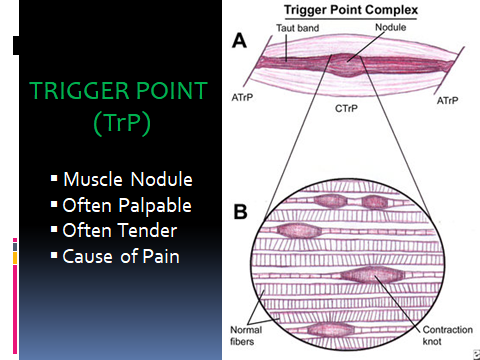
The trigger point region consists of muscle knots from muscle-nerve interaction stemming from injury. Muscle knots form a muscle nodule, which is often palpable and tender when pressed. When a muscle has a lot of contracted fibers, the whole muscle becomes shortened and this results in compression of blood vessels and nerve branches in the trigger point region. This causes compression pain in the involved muscle. Sometimes, the range of motion becomes limited. The shortened muscles also pull the muscles that are attached to the bone. This creates ‘pulling’ pain at the level of joint, as in ‘tennis elbow’.
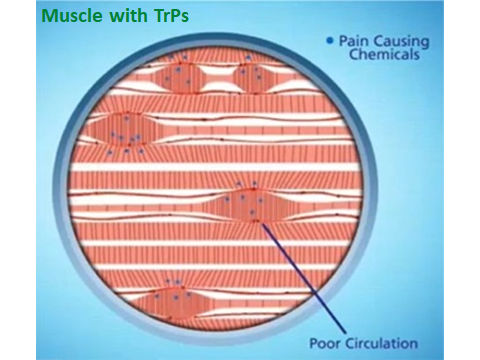
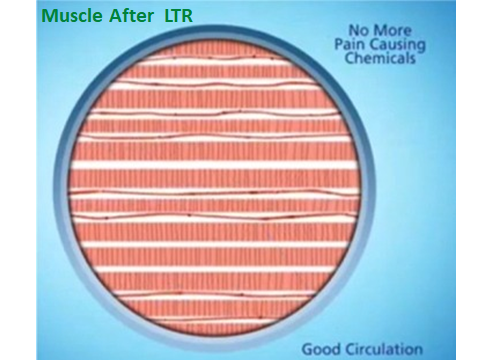
Shah and his collaborators at NIH collected a fluid sample from a trigger point before and after LTR, respectively. From the sample before eliciting a LTR, they were able to detect pain-causing chemicals.
But from the sample collected at the same point after eliciting a LTR, pain chemicals were not detected. This is an experimental proof of Hong’s finding that pain is eliminated after eliciting a LTR.
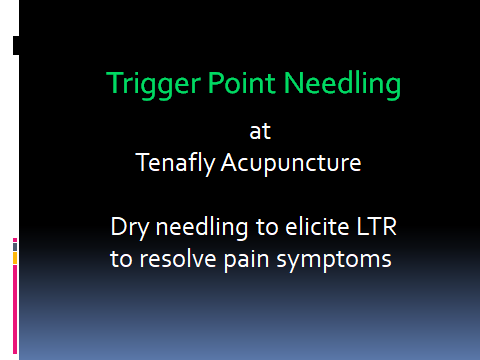
At Tenafly Acupuncture, we palpate injured muscles to find trigger points. These points are then needled with acupuncture needles to elicit local twitch responses (LTRs).
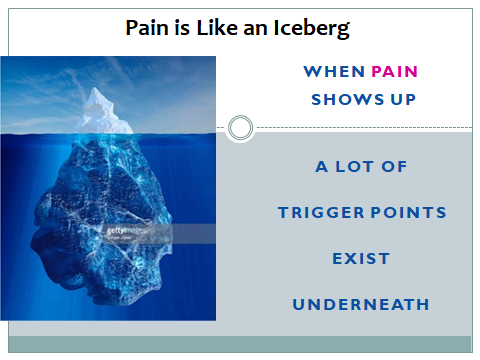
When a patient experiences pain due to an injury, there are many trigger points in the involved muscles.
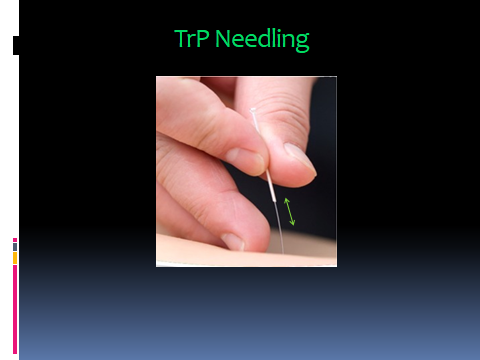
An acupuncture needle is inserted into a tight trigger point in the ropy muscle band, and the needle is moved up and down to elicit local twitch responses (LTRs).
LTRs elicited are classified in terms of their twitching strength: patient-feels-only LTR (referred to as ‘EMG level in the picture); LTRs that are palpable by fingers of the practitioner; LTRs that are visible to the practitioner; and forceful LTRs that involve the contraction of the entire muscle band.
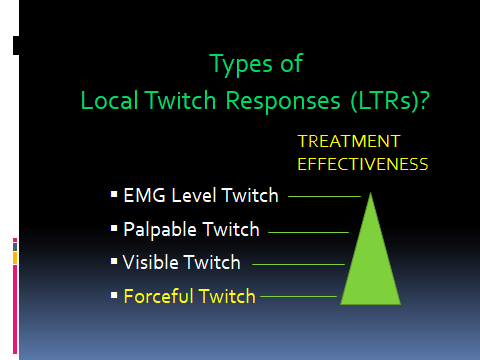
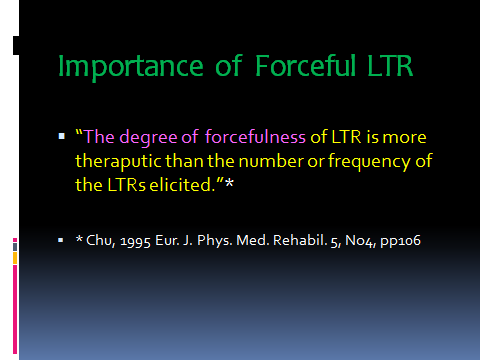
Pain relief is proportional to the strength of the LTR – forceful twitches are the most effective.
Trigger Point Needling Acupuncturists for Muscle Tightness, Stiffness, and Better Flexibility
Your muscles respond to every movement you repeat each day. Long hours at a desk, lifting children, playing sports, driving, or even sleeping in the same position can slowly change how your muscles work. At first, the body adjusts without obvious signs. Over time, those changes can lead to tight muscle bands, stiffness, reduced flexibility, and movement that feels harder than it should. The discomfort you notice today may have started weeks or even months earlier. At Tenafly Acupuncture, I focus on identifying these hidden movement patterns instead of chasing symptoms. As one of the trusted trigger point needling acupuncturists in Cresskill, NJ, my goal is to help your muscles return to healthy function through personalized care that matches the way your body actually moves.
Trigger Points Are Small Muscle Changes That Can Create Bigger Movement Problems
Many people think a trigger point is simply a knot in the muscle. It is much more than that. A trigger point is a small area where muscle fibers stay contracted instead of relaxing normally. This constant tension reduces healthy blood flow, limits muscle length, and changes the way nearby muscles work. As your body compensates, flexibility decreases, and everyday movements may require more effort. A simple task such as reaching overhead, bending down, or turning your head can begin to feel restricted. My assessment focuses on finding these patterns so that treatment addresses the source of muscle dysfunction instead of only the place where discomfort is felt.
Why Dry Needling Trigger Points Is Focused on Restoring Muscle Quality
Healthy muscles should feel responsive, flexible, and balanced. Tight muscles often lose this balance because the muscle fibers remain active even during rest. Through dry needling trigger points, I help encourage those muscles to relax naturally while improving their ability to contract and release efficiently. The purpose is not simply to reduce tightness for a short period. The goal is to improve muscle quality so movement feels smoother, stronger, and more natural throughout your daily routine. Every treatment at Tenafly Acupuncture is planned according to how your muscles function rather than following the same routine for every patient.
Flexibility Is Built Through Healthy Muscle Performance, Not Endless Stretching
Many people stretch every day but continue feeling stiff. This happens because flexibility depends on healthy muscle behavior, not just muscle length. A muscle that cannot relax properly will continue resisting movement no matter how often it is stretched. By improving muscle function first, flexibility becomes easier to achieve and easier to maintain. Patients seeking trigger point dry needling in Cresskill, NJ, often notice that everyday activities begin feeling smoother because their muscles are working together instead of fighting against each other. My focus is on helping your body move with greater ease instead of relying on temporary improvements.
Everybody Creates Its Own Movement Story
No two people develop muscle tightness for the same reason. One person develops stiffness from repetitive lifting, another from years of office work, while someone else notices reduced flexibility after sports or regular exercise. Even if symptoms appear similar, the muscles involved are often completely different. That is why every appointment at Tenafly Acupuncture begins with understanding your movement history, daily routine, and physical demands. I study how your muscles work together, how your joints move, and where unnecessary stress has developed. This allows me to create a treatment strategy designed specifically for your body rather than applying a standard protocol.
Better Results Begin With Better Muscle Decisions
Successful treatment is not about treating every tight muscle. Some muscles need to relax, while others need to become active again. Treating only the painful area may overlook the muscles that caused the problem in the first place. My approach focuses on understanding muscle relationships across the body. This creates more balanced movement and reduces the chance of recurring stiffness. Patients searching for trigger point physical therapy in Cresskill, NJ, often appreciate this complete perspective because it focuses on improving how the entire movement system performs instead of managing isolated symptoms.
Personalized Care That Supports How You Want to Live
The value of treatment is measured by what you can comfortably do afterward. You may want to exercise without feeling restricted, complete your workday with less muscle fatigue, enjoy time with your family, or simply wake up feeling more comfortable. Your goals shape every recommendation I make. As one of the experienced trigger point needling acupuncturists in Cresskill, NJ, I believe treatment should fit your lifestyle instead of expecting your lifestyle to fit the treatment.
At Tenafly Acupuncture, I combine careful assessment with personalized trigger point therapy to help improve muscle function, restore flexibility, and support better movement throughout your daily life. Visit my website to learn more about my approach and schedule your appointment. Together, we can build a treatment plan that helps your body move with greater freedom, confidence, and lasting comfort.
FAQs
How does trigger point needling help improve flexibility?
Trigger point needling helps release tight muscle fibers, improve muscle function, and support smoother movement. My personalized approach focuses on restoring natural flexibility instead of masking symptoms.
Who can benefit from trigger point needling therapy?
Anyone experiencing muscle tightness, stiffness, reduced flexibility, or movement restrictions may benefit. I evaluate your condition carefully to recommend treatment that supports your recovery and lifestyle.
How is trigger point needling different from regular muscle therapy?
Trigger point needling targets specific muscle trigger points that may affect movement and comfort. At Tenafly Acupuncture, I personalize every session based on your muscle function and recovery goals.
Why choose Tenafly Acupuncture for trigger point needling?
I provide individualized care by assessing how your muscles work together, creating treatment plans that improve flexibility, movement quality, and long-term muscle health based on your unique needs.